
Question
In light of the recent NISRA figures showing an almost four fold increase in stop and search under TACT Sections 43 and 43A from 2024/25 to 2025/26 and that of 1,580 stops and searches there were only three arrests
(a) Could the CC set out the reasons for this increase?
In addition, given that TACT stops and searches are based on having a
reasonable suspicion of there being terrorism related activity
(b) Why have these searches led to so few outcomes?
Stops generally
The Committee noted that while the number of stops per 000 population is close to the average for England and Wales, PSNI has the second worst outcome in terms of stops resulting in arrests across the 44 police forces in England, Wales and Northern Ireland. Is there any reason for such a poor outcome and what can be done to improve the situation?
Answer
In the Independent Reviewer of the Terrorism Acts 2024 Report (published May 2026), the Reviewer commented on the use of Section 43 and 43A powers: 9.19 Since individual officers are free to choose between stop and search regimes (JSA and Terrorism Act) there must be a theoretical risk of perverse incentives to use one rather than the other. I should stress that I have seen absolutely no indication of this, but the existence of overlapping powers, occupying in many respects the same domain of countering terrorism and the methods of terrorism, is not ideal. The relevant Code of Practice does not address the overlap.
During 2025 the Independent Reviewer of Justice & Security (NI) Act 2007 (IRJSA) powers submitted a query to PSNI (as research into their upcoming 18th report to parliament) regarding a noted increase in the use of Terrorism Act stop and search powers. In November of 2025 PSNI responded that officers from Crime Department delivered a number of focused briefings to police officers within frontline policing. These briefings included a section on powers and policy available to officers when mitigating the terrorist threat, necessity thresholds and signposted colleagues to Operational Briefing Pages. Stop and search is one overt tactic available to police to mitigate terrorist risk and officer briefings can provide sufficient justification to stop individuals under the Terrorism Act. These briefings had been delivered both on line and in person.
Additionally and due to close work between the PSNI and the IRJSA, since February 2024 much work has been progressed by the PSNI’s Police Powers Development Unit (PPDU) towards increasing officer awareness around the requirement for a lawful basis to search under Section 24(3) of the Justice & Security (NI) Act 2007 and when a search under Section 43 & 43A of the Terrorism Act 2000 may be more appropriate. This PPDU work has involved both direct engagement with officers and their supervisors after carrying out quality assurance checks on stop search encounters and presentations directly to PSNI district support police teams (DST’s), who had been operating in the areas where Justice & Security (NI) Act powers had been used most frequently.
The information presented to officers by the PSNI’s PPDU included discussions around the requirement for a lawful basis and information from the Code of Practise for the Exercise of Powers in the Justice and Security (NI) Act 2007 which at 8.51 outlines “Officers should be reminded that other powers of stop and search (including powers exercisable on reasonable suspicion) may be more appropriate to use.”
Through direct contact with officers regarding the basis which they had provided for stop search encounters and through presentations to those officers who used the powers the most, it was an expected consequence that better awareness of the powers may lead to officers more appropriately selecting a power that requires reasonable suspicion, when such reasonable suspicion exists. The work being carried out by the PSNI’s PPDU is believed to be the primary reason for the decrease in use of Justice & Security (NI) Act powers and the increase in the use of Terrorism Act powers relating to stop and search and that this work is leading to police officers more often exercising powers under section 43 of the Terrorism Act 2000 on individuals whom they reasonably suspect to be a terrorist, to discover whether he/she has in his/her possession, anything which may constitute evidence that he/she is a terrorist.
The PACE (NI) Order 1989 Code of Practice A states “1.4 The primary purpose of stop and search powers is to enable officers to allay or confirm suspicions about individuals without exercising their power of arrest.”
More specifically, the Code of Practice to the Terrorism Act 2000 PRINT VERSION Draft Code of Practice for Stop and Search powers under the Terrorism Act 2000 20.05.24 states at 5.5; “The primary purpose of stop and search powers under Part V of the Terrorism Act 2000 is to protect the public by enabling police officers to prevent and detect acts of terrorism.”
At 6.2 the Code further states, “Reasonable grounds for suspicion depend on the circumstances in each case. There must be an objective basis for that suspicion based on facts, information, and/or intelligence which are relevant to: ● in the case of searches under section 43 of the Terrorism Act 2000, to the likelihood that the person is a terrorist; ● in the case of searches under section 43A of the Terrorism Act 2000, to the likelihood that the vehicle is being used for the purposes of terrorism.”
In the Use of Stop and Search Powers by the Police in Northern Ireland (April 2025 to 31 March 2026) published on 20th of May 2026, it is outlined at figure 8 on page 12 (Principal outcome of stop and search during 1st April 2024 to 31st March 2025) that 26 out of every 100 stops in England and Wales resulted in an outcome whereas 28 out of every 100 stops in Northern Ireland resulted in an outcome (Note - Justice & Security (NI) Act statistics are excluded from this data for a reliable comparator as these powers are not available in England and Wales). This data showed that in Northern Ireland (during that time period) report to public prosecution service and community resolution notice was used in a higher percentage of stops than in England and wales. This data also showed that in Northern Ireland a significantly lower percentage of people were arrested than in England and Wales, as a result of a stop and search encounter. This data demonstrates that PSNI officers are considerate around which method of disposal they use following a stop search encounter when they discover an item, resulting in a lower percentage of people getting arrested and a higher percentage of people being reported for an offence or issued with a community resolution notice. This approach gives cognisance to limiting the depravation of an individual’s right to liberty in favour of a less intrusive method of disposal.
The tables below show the outcomes of stop and searches in England and Wales and Northern Ireland for the period 1 April 2024 to 31 March 2025. In the interest of comparability, the NI figures exclude stops under JSA Section 21 and 24.
Outcome of stop and searches in England and Wales, April 2024 to March 2025(1,3,4,5)
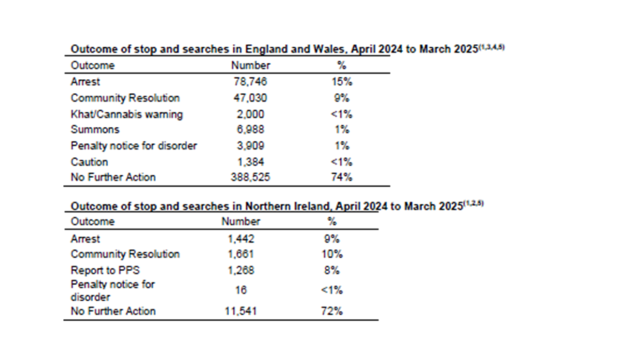
(1) The latest data available for England and Wales is 2024/25 (Police powers and procedures, England and Wales, year ending March 2025). For comparability, the 2024/25 NI figures are also shown.
(2) In the interest of comparability, the NI figure excludes stops under JSA Section 21 and 24.
(3) England and Wales figures include vehicle only searches (3% of all searches). Northern Ireland figures do not.
(4) ‘No further action’ figures for England and Wales include voluntary attendance, verbal warning, seizure of property, guardian intervention and other action.
(5) Percentages may not sum to 100% due to rounding.